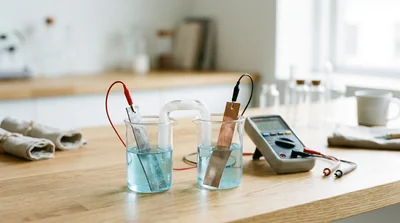
Predicting whether mixing two solutions will produce a precipitate is a routine general-chemistry task, but only if you know the solubility rules. These are rules of thumb — not absolutes — that tell you which ionic compounds dissolve freely in water and which fall out as solids. This guide on solubility rules lists the soluble-first set in the order most worth memorizing, names the few exceptions to keep an eye on, and uses them on two worked examples of double-replacement reactions.
What "Soluble" Means Here
In solubility rules, soluble means the salt dissolves enough to count as fully dissociated in water — say, more than about 0.01 M of dissolved ions. Insoluble means it does not dissolve appreciably (well below 0.01 M) and would appear as a solid precipitate if formed in solution. Slightly soluble is the middle case — it shows up enough that a textbook will list it, but you treat it case-by-case.
The same compound's solubility depends on temperature, but the rules below cover near-room-temperature aqueous solutions. They are good enough to predict almost every precipitation reaction you will see in an intro course.
The Soluble-First Rules (Memorize These)
It is easier to memorize a short list of "always soluble" cations and anions and then list the exceptions, than to memorize "insoluble" rules from scratch. Here is the soluble-first list.
Always soluble (cations):
- Alkali metal cations (Li⁺, Na⁺, K⁺, Rb⁺, Cs⁺) — every salt of a Group 1 metal dissolves.
- Ammonium (NH₄⁺) — every ammonium salt dissolves.
Always soluble (anions, with named exceptions):
- Nitrates (NO₃⁻) — every nitrate dissolves. No exceptions worth memorizing.
- Acetates (CH₃COO⁻) — every acetate dissolves. (Silver acetate is borderline.)
- Chlorides, bromides, iodides (Cl⁻, Br⁻, I⁻) — usually soluble. Exceptions: Ag⁺, Pb²⁺, Hg₂²⁺. Those three form insoluble halides.
- Sulfates (SO₄²⁻) — usually soluble. Exceptions: Ba²⁺, Sr²⁺, Pb²⁺, plus Hg₂²⁺. Ca²⁺ is borderline (CaSO₄ is slightly soluble).
That is the entire "soluble" half of the rules, except for one combined oddity: alkali-metal sulfides and hydroxides dissolve well (because Li⁺/Na⁺/K⁺ override the usually-insoluble nature of S²⁻ and OH⁻).
The Insoluble-First Rules (Three Anions to Watch)
Three anions are usually insoluble, with alkali metals and ammonium as the standard exceptions.
- Carbonates (CO₃²⁻) — usually insoluble. Exceptions: alkali metals and NH₄⁺.
- Phosphates (PO₄³⁻) — usually insoluble. Same exceptions.
- Sulfides (S²⁻) — usually insoluble. Exceptions: alkali metals, NH₄⁺, and the alkaline-earth metals are generally soluble too.
- Hydroxides (OH⁻) — usually insoluble. Exceptions: alkali metals (Ba(OH)₂ and Sr(OH)₂ are also soluble; Ca(OH)₂ is slightly soluble).
So most carbonates, phosphates, sulfides, and hydroxides precipitate. The pattern: pair one of those anions with a non-alkali, non-ammonium cation and assume insoluble until you check.

Using the Rules on a Double-Replacement Reaction
A double-replacement reaction mixes two soluble ionic compounds and asks whether anything precipitates. The procedure:
- Write the two reactants as fully dissociated ions in solution.
- Swap the partners on paper to find the two possible products.
- Check each possible product against the solubility rules.
- If one (or both) is insoluble, that is the precipitate. If both are soluble, no reaction.
Worked example 1: AgNO₃ + NaCl
Mix aqueous silver nitrate and sodium chloride.
Ions present: Ag⁺, NO₃⁻, Na⁺, Cl⁻.
Possible products from swapping: AgCl and NaNO₃.
Check AgCl: chlorides are usually soluble, but Ag⁺ is an exception — AgCl is insoluble. Check NaNO₃: nitrates always soluble; alkali metals always soluble. Soluble.
So AgCl precipitates. Net ionic equation: Ag⁺(aq) + Cl⁻(aq) → AgCl(s). The Na⁺ and NO₃⁻ are spectator ions and do not appear in the net ionic equation.
Worked example 2: BaCl₂ + Na₂SO₄
Mix aqueous barium chloride and sodium sulfate.
Ions: Ba²⁺, Cl⁻, Na⁺, SO₄²⁻.
Swap: BaSO₄ and NaCl.
Check BaSO₄: sulfates usually soluble, but Ba²⁺ is an exception — BaSO₄ is insoluble. Check NaCl: soluble (Na⁺ is alkali metal, Cl⁻ standard).
So BaSO₄ precipitates. Net ionic equation: Ba²⁺(aq) + SO₄²⁻(aq) → BaSO₄(s). The white precipitate of barium sulfate is the basis for the medical "barium meal" X-ray test — even though Ba²⁺ is toxic, BaSO₄ is so insoluble that essentially none of the barium gets into the bloodstream.
A case with no reaction
Mix KNO₃ and NaCl. Ions: K⁺, NO₃⁻, Na⁺, Cl⁻. Swap → KCl and NaNO₃. Both are soluble (alkali-metal cations, friendly anions). Nothing precipitates. No reaction.
A Note on Spectator Ions
In the worked examples, Na⁺ and NO₃⁻ never participated — they stayed dissolved before and after. Those are spectator ions, and the net ionic equation drops them so only the species that actually changed appear. Stripping out spectators is good practice; the net ionic equation is what a chemistry instructor usually wants on a precipitation problem.
K(sp): When the Rules Run Out
The rules above are binary — soluble or not. The actual chemistry is a continuum, captured by the solubility product K(sp), the equilibrium constant for a solid dissolving:
AgCl(s) ⇌ Ag⁺(aq) + Cl⁻(aq), K(sp) = [Ag⁺][Cl⁻]
A small K(sp) means the salt barely dissolves. K(sp) lets you compute exact solubilities and predict whether a precipitate will form from specific concentrations (compare Q to K(sp) the way you would for any equilibrium). For routine "will this precipitate?" questions, the binary rules are enough — when a problem hands you concentrations and asks for a numerical answer, that is when K(sp) comes in.
Getting Help
Solubility rules sit on top of the same chemical equilibrium framework as every K(eq) topic — K(sp) is just the K of a dissolution reaction. For the bigger map of how to read any chemical equation correctly, see balancing chemical equations.
Conclusion
Solubility rules are short enough to memorize. Alkali-metal and ammonium salts always dissolve. Nitrates and acetates always dissolve. Chlorides, bromides, iodides, and sulfates usually dissolve, with a handful of named exceptions (Ag⁺, Pb²⁺, Hg₂²⁺ for the halides; Ba²⁺, Sr²⁺, Pb²⁺ for sulfates). Carbonates, phosphates, sulfides, and hydroxides usually do not dissolve, with the alkali metals and ammonium as exceptions. Apply the rules to a double-replacement swap, identify the precipitate, and write the net ionic equation by dropping the spectator ions.