
A galvanic cell turns a spontaneous redox reaction into electrical work — the chemistry behind every battery you have ever used. The setup looks fiddly: two beakers, a salt bridge, a wire, an electrode in each beaker. The math behind it is simpler than the diagram suggests. This guide on galvanic cells and cell potential walks through the parts of the cell, the rule for which electrode is which, and the one-line formula for computing the standard cell potential E°(cell), worked on a zinc–copper cell.
Why a Galvanic Cell Exists
If you drop a strip of zinc metal into a solution of copper(II) sulfate, the zinc dissolves and copper metal plates out on what is left of the zinc strip — the spontaneous redox reaction
Zn(s) + Cu²⁺(aq) → Zn²⁺(aq) + Cu(s)
happens directly in the beaker. The electrons transfer from Zn to Cu²⁺ across the surface where they touch. Useful, but the electrons go nowhere you can tap.
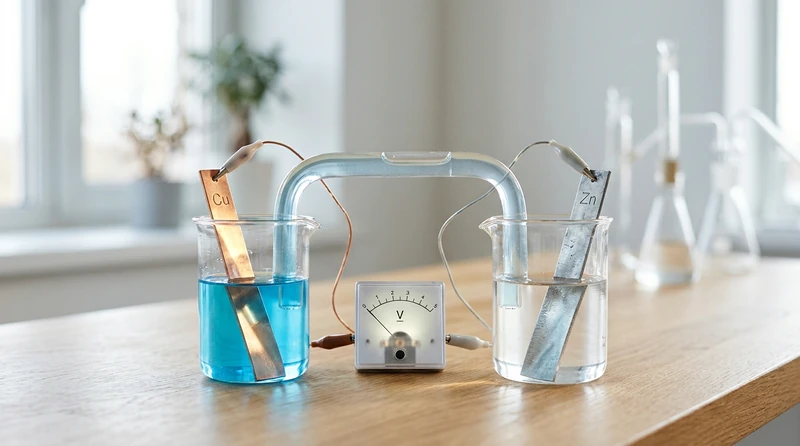
A galvanic cell separates the two halves into different beakers, connected by a wire on the outside and a salt bridge on the inside. The zinc still wants to give up electrons and the Cu²⁺ still wants to grab them, but now those electrons have to travel through the wire to get from one side to the other — and along that wire they can run a light bulb, drive a motor, or charge a phone. The chemistry is the same; the geometry of the apparatus channels the energy into electrical work.
The Parts of a Galvanic Cell
A galvanic cell has five components.
- Two half-cells — each one a beaker holding a solution of a metal salt and a strip of that metal (the electrode) dipped into it.
- The anode — the electrode where oxidation happens. Electrons are released here.
- The cathode — the electrode where reduction happens. Electrons arrive here.
- The external wire — connects the two electrodes. Electrons flow from anode to cathode through the wire.
- The salt bridge (or porous membrane) — connects the two solutions internally, lets ions pass through, and keeps charge from building up. Without it, the half-cells would become so charged after a few seconds that the reaction would stop.
The mnemonic AN-OX, RED-CAT: oxidation at the anode, reduction at the cathode. The anode is the negative terminal of a galvanic cell (it sends electrons out) and the cathode is positive (it pulls electrons in). Ions in the salt bridge move to balance charge: cations migrate toward the cathode side, anions toward the anode side.
Choosing Which Half-Cell Is the Anode
Every half-cell has a tabulated standard reduction potential E°, measured against a hydrogen reference electrode at 1 M and 1 atm. A more positive E° means the half-reaction has a stronger pull to be reduced; a more negative E° means it would rather be oxidized.
In a galvanic cell, the half-cell with the higher (more positive) E° becomes the cathode, and the other becomes the anode. The reaction at the anode is the reverse of the tabulated half-reaction, because oxidation is the reverse of the reduction listed in the table.
For the zinc–copper cell:
- Cu²⁺ + 2 e⁻ → Cu, E° = +0.34 V
- Zn²⁺ + 2 e⁻ → Zn, E° = −0.76 V
Cu²⁺/Cu has the higher E°, so it is the cathode: Cu²⁺ + 2 e⁻ → Cu happens there. Zn²⁺/Zn has the lower E°, so it is the anode and its reaction is reversed: Zn → Zn²⁺ + 2 e⁻.
Computing E°(cell)
Two equivalent formulas. The one most students learn:
E°(cell) = E°(cathode) − E°(anode)
where both values come straight from the standard-reduction-potential table (do not flip the sign on the anode value first — the minus sign in the formula already handles the flip).
For the Zn–Cu cell: E°(cell) = (+0.34) − (−0.76) = +1.10 V.
A positive E°(cell) means the cell reaction is spontaneous as written — the galvanic cell will run. A negative E°(cell) would mean the reaction wants to go the other way, and you would have to drive it with an external power source (that is an electrolytic cell, not a galvanic one).
Two reasons this formula works. First, by always picking the higher-E° species as cathode, you guarantee E°(cell) > 0 — galvanic cells are spontaneous by construction. Second, the formula does not depend on how many moles of electrons transferred or on the coefficients used to balance the equation: E° is an intensive property, not an extensive one. Doubling the coefficients does not double E°.
Writing the Overall Cell Reaction
Combine the two half-reactions so the electrons cancel. For the Zn–Cu cell, both halves involve 2 e⁻, so no scaling is needed.
- Anode: Zn → Zn²⁺ + 2 e⁻
- Cathode: Cu²⁺ + 2 e⁻ → Cu
- Sum: Zn + Cu²⁺ → Zn²⁺ + Cu, E°(cell) = +1.10 V
The standard cell notation packages the same information compactly:
Zn(s) | Zn²⁺(aq) || Cu²⁺(aq) | Cu(s)
Anode on the left, cathode on the right, single bars for phase boundaries within a half-cell, double bars for the salt bridge between half-cells. That shorthand shows up on exam questions even when the diagram does not.
A Note on n and ΔG°
E°(cell) connects to the free-energy change of the cell reaction through
ΔG° = −n F E°(cell)
where n is the number of electrons transferred per cell reaction (here, 2) and F is Faraday's constant (96,485 C/mol). For the Zn–Cu cell: ΔG° = −(2)(96,485)(1.10) = −212 kJ/mol. The negative ΔG° confirms spontaneity. This is where the link to thermochemistry lives — the electrical voltage and the free-energy change are tied together by a single conversion factor.
Getting Help
Galvanic-cell math sits on top of redox identification, so redox reactions explained and balancing redox equations are the prerequisites. For the thermodynamic side of the same coin — how ΔG° determines whether the cell can run — see Gibbs free energy explained.
Conclusion
A galvanic cell channels a spontaneous redox reaction through an external wire so its electrons do work. Two half-cells, two electrodes, one salt bridge: the higher-E° half-cell is the cathode (reduction), the lower-E° half-cell is the anode (oxidation). E°(cell) = E°(cathode) − E°(anode), and a positive value means the cell runs spontaneously. Once you have the two reduction potentials and a clear sense of which side is which, computing cell potential is one line of arithmetic.