
Most students balance chemical equations by guessing coefficients until the atom counts happen to match. That works on easy problems and falls apart on hard ones. There is a faster way: a fixed order of operations that tells you which element to touch first and which to save for last. Once you balance chemical equations this way, the guessing stops.
What "Balanced" Actually Requires
A chemical equation is balanced when every element has the same number of atoms on the reactant side and the product side. That requirement comes straight from the law of conservation of mass — atoms are not created or destroyed in a reaction, only rearranged.
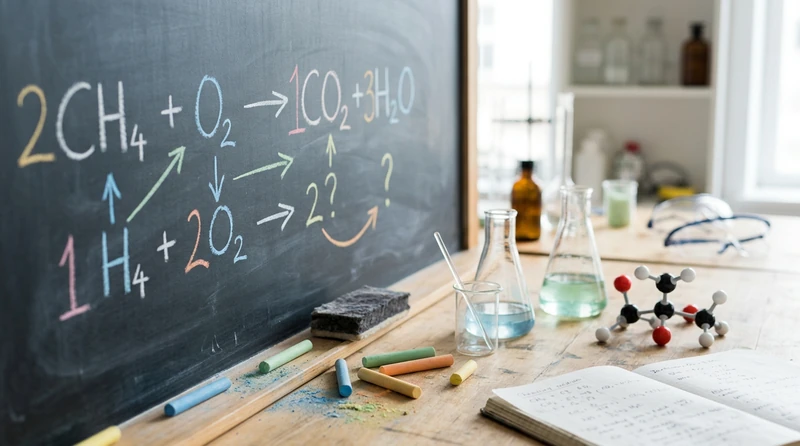
You balance by changing coefficients, the numbers in front of formulas. You never change subscripts, the small numbers inside a formula, because that would change the substance itself. Turning H₂O into H₂O₂ does not balance oxygen; it swaps water for hydrogen peroxide. So the only knob you may turn is the coefficient, and a coefficient multiplies every atom in the formula that follows it.
The Method: Hardest Element First, Pure Elements Last
Here is the order that removes the guesswork. Follow it every time.
- Pick the most complex molecule — the formula with the most atoms or the most different elements — and give it a coefficient of 1.
- Balance the element that appears in the fewest places next, usually a metal or a polyatomic ion. Set its coefficient to match.
- Balance the remaining compound elements, one at a time, leaving hydrogen and oxygen until near the end because they tend to show up everywhere.
- Balance oxygen, then hydrogen.
- Clear fractions. If a coefficient came out as ½ or ⅓, multiply the whole equation through to make every coefficient a whole number.
- Check every element, left against right.
The principle behind the order: lock down the elements that have only one possible home before you touch the ones — oxygen and hydrogen especially — that float across many compounds.
Worked Example: Combustion of Propane
Propane burning is C₃H₈ + O₂ → CO₂ + H₂O. Apply the method.
The most complex molecule is C₃H₈, so give it a coefficient of 1. Now carbon: all 3 carbons must land in CO₂, so CO₂ gets a 3. Hydrogen next: 8 hydrogens on the left must end up in H₂O, and each water holds 2, so H₂O gets a 4.
Oxygen comes last. The right side now has 3 CO₂ (6 oxygens) plus 4 H₂O (4 oxygens), for 10 oxygen atoms. Each O₂ supplies 2, so O₂ needs a coefficient of 5.
The balanced equation is C₃H₈ + 5 O₂ → 3 CO₂ + 4 H₂O. Check: carbon 3 = 3, hydrogen 8 = 8, oxygen 10 = 10. Done — and not one guess was made.
When a fraction appears
Run the same steps on C₂H₆ + O₂ → CO₂ + H₂O and oxygen comes out to 7/2. That is fine mid-problem. Multiply every coefficient by 2 to clear it: 2 C₂H₆ + 7 O₂ → 4 CO₂ + 6 H₂O. Fractions are a tool, not a mistake — they let you finish the balance, then you scale up at the end.
A Harder Case: Treating a Polyatomic Ion as One Unit
When the same polyatomic ion stays intact on both sides, balance it as a single unit instead of element by element. Take Al₂(SO₄)₃ + Ca(OH)₂ → Al(OH)₃ + CaSO₄.
The sulfate ion SO₄ appears whole on both sides, so treat "SO₄" as one item. Start with Al₂(SO₄)₃: it has 2 aluminum and 3 sulfate. So Al(OH)₃ gets a 2 and CaSO₄ gets a 3. Calcium: 3 on the right forces Ca(OH)₂ to 3. Check hydroxide OH: the left now has 3 Ca(OH)₂ = 6 OH, and the right has 2 Al(OH)₃ = 6 OH. They match.
The balanced equation is Al₂(SO₄)₃ + 3 Ca(OH)₂ → 2 Al(OH)₃ + 3 CaSO₄. Counting OH as one group instead of separate O and H atoms cut the work in half.
Three Mistakes That Waste the Most Time
Even with the method, three habits slow students down. Catch them and the process speeds up.
Re-counting from scratch after every change. You do not need to. After you set a coefficient, only update the elements that coefficient touched. Track the running atom count rather than recounting the whole equation each time.
Forgetting that a coefficient distributes. A coefficient of 3 in front of Ca(OH)₂ means 3 calcium, 6 oxygen, and 6 hydrogen — it multiplies every atom in the formula, including the atoms inside parentheses. Missing this is the most common source of a balance that "almost" works.
Reducing coefficients at the end. A finished equation should use the smallest whole-number ratio. If you end with 2 H₂ + 1 O₂ → 2 H₂O that is already lowest terms, but 4 H₂ + 2 O₂ → 4 H₂O is not — divide every coefficient by the common factor 2. Many instructors mark an un-reduced equation wrong even though the atoms balance.
Getting Help
Balancing is the foundation for the calculations that come next — once an equation is balanced, its coefficients become the mole ratios you use for conversions. See stoichiometry: the mole map for what to do with those ratios, or browse the full set of General Chemistry study guides.
Conclusion
You do not have to balance chemical equations by trial-and-error. Anchor the most complex molecule at 1, balance the rarest elements first, save oxygen and hydrogen for last, clear any fractions, and verify. The method is mechanical on purpose — it turns a puzzle into a checklist that works on combustion, double-replacement, and polyatomic-ion reactions alike.