
Job order costing trips students up because the textbook explains the accounts before it ever shows a single job moving through them. This guide does it the other way around: we follow one job — a custom set of 50 conference tables — from the first sheet of plywood to a finished cost per unit. By the end you will be able to take any job and answer the question every exam asks: what did it cost?
When You Use Job Order Costing
Job order costing is the method you use when products are made in distinct, identifiable batches and each batch is different. A furniture shop building custom tables, a print shop running one client's brochures, a law firm billing a case, a contractor framing a house — each of these is a job, a unique unit of work that costs get attached to.
The contrast is process costing, used when identical units flow continuously — gallons of paint, bottles of soda. If a problem describes one specific order for one customer, it wants job order costing. If it describes a department churning out interchangeable units, it wants process costing. Picking the wrong method is the most common way these problems go off the rails, so settle that question first.
The Three Costs on a Job Cost Sheet
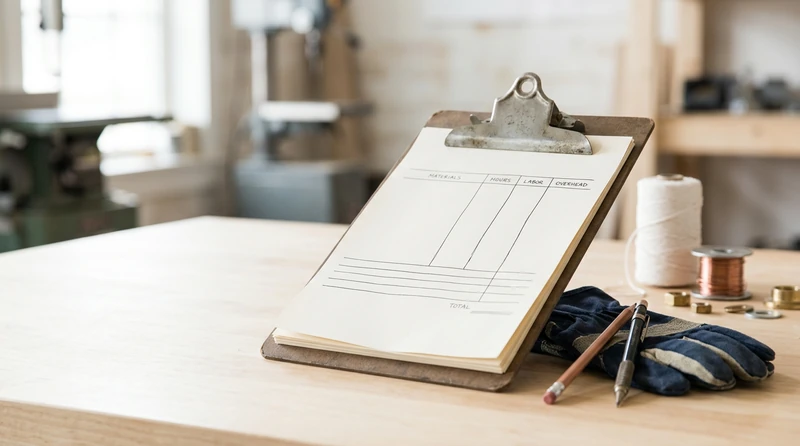
Every job carries a job cost sheet — a single document that accumulates three things, and only three things:
- Direct materials — materials you can trace directly to the job, like the plywood and hardware in our tables.
- Direct labor — the wages of workers whose time you can trace directly to the job, like the carpenters' hours.
- Manufacturing overhead — every other manufacturing cost: factory rent, equipment depreciation, the supervisor's salary, glue, sandpaper. These cannot be traced to one job, so they are applied using a rate (more on that next).
Add those three and you have the total cost of the job. Costs that are not manufacturing — sales commissions, the office accountant's salary, delivery — never touch the job cost sheet. They are period costs, expensed straight to the income statement.
Applying Overhead With a Predetermined Rate
You cannot trace overhead to a job directly, and you cannot wait until year-end to find out the actual figure — you need a cost while the job is still in the shop. So you use a predetermined overhead rate, calculated before the year starts:
Predetermined overhead rate = Estimated total overhead ÷ Estimated total amount of the allocation base
The allocation base is the activity you think drives overhead — usually direct labor hours or machine hours. Suppose our furniture shop estimates $300,000 of overhead for the year and 20,000 direct labor hours. The rate is $15 per direct labor hour. Every job then absorbs overhead at $15 for each labor hour it uses. This is the step that confuses people most, so hold onto it: overhead is applied, not measured.
Worked Example: The Conference Table Job
Job 118 is 50 conference tables. As the job runs, the cost sheet fills in:
- Direct materials. The shop's storeroom issues $9,200 of plywood, veneer, and steel legs to Job 118. That comes from materials requisition forms, and it posts straight to the sheet.
- Direct labor. Carpenters log 320 hours on Job 118 at $22 per hour. Direct labor cost is 320 × $22 = $7,040.
- Applied overhead. Overhead is applied on direct labor hours at the $15 rate. Job 118 used 320 hours, so applied overhead is 320 × $15 = $4,800.
Total cost of Job 118 = $9,200 + $7,040 + $4,800 = $21,040.
Cost per table = $21,040 ÷ 50 = $420.80. If the shop prices jobs at cost plus 40%, Job 118 sells for $21,040 × 1.40 = $29,456.
Notice the only estimated piece is overhead. Materials and labor are actual amounts traced from real documents; overhead is applied with the rate set back at the start of the year.
Where the Costs Flow Afterward
The cost sheet is not the end of the trail. While Job 118 is being built, its costs sit in Work in Process inventory. When the tables are finished, the $21,040 moves to Finished Goods inventory. When the tables ship to the customer, that $21,040 moves to Cost of Goods Sold on the income statement, matched against the $29,456 of revenue.
Because the overhead figure is applied, not actual, the year almost never balances perfectly. If applied overhead exceeds actual overhead, overhead is overapplied; if it falls short, it is underapplied. That gap gets cleaned up at year-end, usually closed into Cost of Goods Sold — a separate problem worth understanding on its own.
Getting Help
Job order costing sits next to a method students constantly confuse it with; if you are unsure which one a problem wants, read process costing vs. job costing. When applied overhead comes out wrong, fixing overhead allocation errors walks through why and how to catch it.
Conclusion
How job order costing works comes down to one document and one habit: the job cost sheet collects direct materials, direct labor, and applied overhead, and you build the total one traceable line at a time. Get the predetermined overhead rate right, apply it on the job's actual activity, and the cost per unit falls out cleanly — exactly as it did for the $420.80 conference tables.