
Most students can describe job costing and process costing once prompted. The hard part is the first ten seconds of a problem — deciding which method it is even asking for. Pick wrong and every calculation after it is wasted effort. This guide gives you the deciding question, the tells that appear in problem wording, and a side-by-side look at how each method works.
The One Question That Decides It
Before any math, ask: are the units distinct and identifiable, or identical and interchangeable?
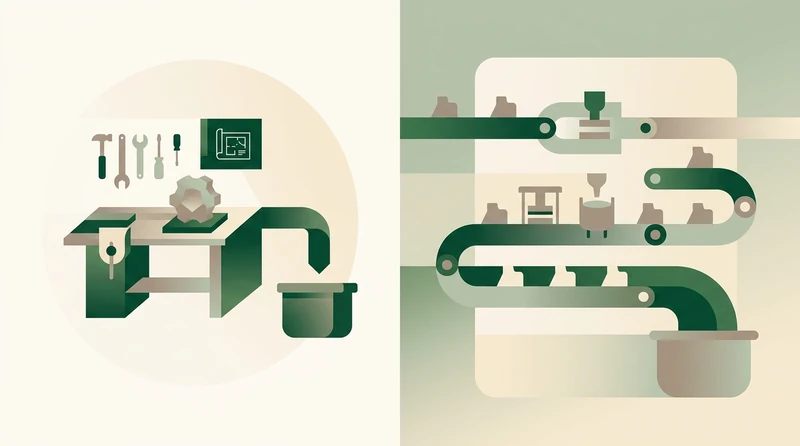
- If the company makes unique batches — each order different from the last — it uses job order costing. A custom home, a specific client's audit, a one-off machine, a print run for one customer.
- If the company makes identical units in a continuous stream — every unit the same as the next — it uses process costing. Gallons of paint, liters of soda, bags of cement, sheets of identical plywood.
That single distinction settles almost every problem. Custom and traceable points to job costing; mass-produced and uniform points to process costing.
The Tells in the Problem Wording
Exam problems rarely say "use process costing" outright. They give signals. Train yourself to spot them.
Job costing tells: the words job, order, client, project, custom, or batch; a job number like "Job 204"; a mention of a job cost sheet; or costs quoted per job. Industries named: construction, custom furniture, printing, consulting, shipbuilding, law.
Process costing tells: the word department or process; costs flowing from one department to the next; production measured in a continuous unit like gallons, pounds, or liters; mention of equivalent units or a production cost report; or costs quoted per department, per month. Industries named: oil refining, food processing, chemicals, paint, cement.
If a problem mentions equivalent units, it is process costing — that concept does not exist in job costing. If it mentions a job cost sheet, it is job costing. Those two terms are reliable giveaways.
How Each Method Accumulates Cost
The two methods collect the same three cost types — direct materials, direct labor, and manufacturing overhead — but attach them to different things.
Job costing accumulates cost by job. Each job carries its own job cost sheet. Costs are traced to that specific job, and when it finishes, you divide its total cost by the units in that job to get a cost per unit. Different jobs can have very different per-unit costs.
Process costing accumulates cost by department or process over a period of time. There is no job sheet — instead, each department totals its costs for the month and spreads them over the units it worked on. Because every unit is identical, the result is a single average cost per unit for that department's output. The work-in-process inventory at the end of the period forces the equivalent units calculation, which converts partly finished units into a count of whole-unit equivalents so the average is fair.
A Worked Contrast
Same numbers, two methods, to see the difference land.
Job costing. A print shop finishes Job 51, a run of 2,000 custom brochures. Its job cost sheet shows $1,400 materials, $900 labor, $700 applied overhead — total $3,000. Cost per brochure = $3,000 ÷ 2,000 = $1.50. Job 52 next week, a different design, will have its own sheet and its own per-unit cost.
Process costing. A bottling plant's mixing department incurs $60,000 of total cost in March and completes the equivalent of 40,000 liters. Average cost = $60,000 ÷ 40,000 = $1.50 per liter. Every liter that left the department in March carries that same $1.50 — there is no "Liter 51" with a cost of its own.
The job method gives a cost to each job; the process method gives an average to a department's whole output.
Notice what each method can and cannot tell you. Job costing can report that Job 51 cost $1.50 per brochure while Job 52 cost $2.10 — useful when you want to know whether a particular order was profitable. Process costing cannot single out one liter; it only knows the department average, which is fine because every liter is identical and there is no "profitable liter" to find. The method fits the product: when units are distinguishable, you want per-job detail; when they are interchangeable, an average is all the information that exists.
Where overhead and inventory differ
Both methods still apply overhead with a predetermined rate, and both move cost through Work in Process, Finished Goods, and Cost of Goods Sold. The difference is the level of detail. Job costing tracks Work in Process job by job — the balance is the total of all unfinished job cost sheets. Process costing tracks Work in Process department by department, and partially finished units in a department are handled through equivalent units rather than individual sheets.
Getting Help
Once you have settled that a problem wants job costing, how job order costing works traces a single job from materials through to a finished cost per unit. For more managerial accounting method guides, see the Accounting study guides.
Conclusion
Process costing vs. job costing comes down to the nature of the product: identical units flowing continuously call for process costing and an average cost per unit; unique, traceable batches call for job costing and a cost per job. Scan the problem for the tells — "department" and "equivalent units" versus "job" and "job cost sheet" — and you will know which method to run before you compute a single number.