
FIFO and LIFO sound like a question about which physical box leaves the warehouse first. They are not. They are cost flow assumptions — rules for which costs get assigned to the units you sold versus the units still on the shelf. Get that straight and a problem that looks like guesswork becomes pure arithmetic. This guide works one example through both methods so you can see exactly where they split.
What FIFO and LIFO Actually Decide
When prices change during a period, the units in your inventory were bought at different costs. Sell some units and you face a question: which costs leave with the sale (becoming cost of goods sold), and which stay behind (becoming ending inventory)?
- FIFO — first in, first out. The earliest costs leave first. COGS is built from the oldest purchase prices; ending inventory holds the most recent prices.
- LIFO — last in, first out. The most recent costs leave first. COGS is built from the newest purchase prices; ending inventory holds the oldest prices.
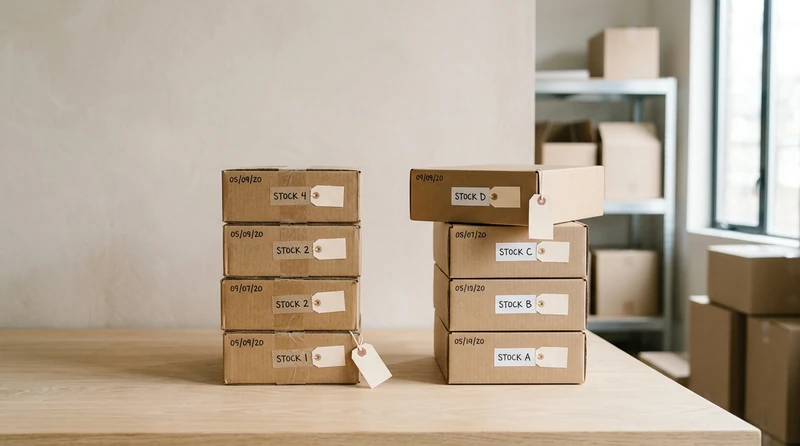
Neither method claims to track which physical item shipped. A grocery store rotates real milk by expiration date no matter which method it uses for the books. FIFO and LIFO are accounting choices about cost, not logistics.
A Worked Example Through Both Methods
A store starts the period with 100 units already on hand and makes two purchases as prices rise:
- Beginning inventory: 100 units at $10 = $1,000
- Purchase 1: 100 units at $12 = $1,200
- Purchase 2: 100 units at $15 = $1,500
Total goods available: 300 units costing $3,700. During the period the store sells 200 units, leaving 100 units in ending inventory. Now split that $3,700.
FIFO. The 200 sold are costed from the oldest layers first: 100 at $10 ($1,000) + 100 at $12 ($1,200) = COGS of $2,200. Ending inventory is the newest 100 units at $15 = $1,500.
LIFO. The 200 sold are costed from the newest layers first: 100 at $15 ($1,500) + 100 at $12 ($1,200) = COGS of $2,700. Ending inventory is the oldest 100 units at $10 = $1,000.
Check the math: under both methods, COGS plus ending inventory equals the $3,700 available. The methods only disagree on how to divide that fixed total.
How the Two Methods Hit the Income Statement
Say all 200 units sold for $20 each — $4,000 of sales revenue under either method. The cost flow choice changes everything below that line:
| Line | FIFO | LIFO |
|---|---|---|
| Sales | $4,000 | $4,000 |
| Cost of goods sold | $2,200 | $2,700 |
| Gross profit | $1,800 | $1,300 |
When prices are rising, FIFO sends the cheap old costs to COGS, so COGS is lower and gross profit is higher. LIFO sends the expensive recent costs to COGS, so COGS is higher and gross profit is lower. The pattern flips when prices fall. The rule worth memorizing: in an inflationary period, FIFO reports higher profit and a higher ending inventory; LIFO reports lower profit and a lower ending inventory.
The effect carries onto the balance sheet too. Ending inventory is an asset, so FIFO's $1,500 versus LIFO's $1,000 means FIFO shows $500 more in current assets. One choice of cost flow assumption ripples through gross profit, net income, the inventory asset, and — because profit drives taxes — the cash the company actually keeps. That is why the choice is treated as a real decision and not a formality.
A shortcut for spotting the answer
On an exam you can often skip the full layer-by-layer work if the question only asks which method gives the higher or lower figure. Decide one thing: are prices rising or falling across the period? If rising, FIFO is the "higher profit, higher inventory" method and LIFO is the "lower profit, lower tax" method. If falling, swap them. The phrase to anchor on is that LIFO puts the latest costs into COGS — so in inflation, the latest costs are the biggest, and COGS is biggest under LIFO.
Why a Company Would Choose LIFO
If FIFO shows a healthier profit, why would any company pick LIFO? Taxes. Lower reported profit under LIFO means a lower taxable income and a smaller tax bill in periods of rising prices — a real cash saving. That tax motive is the main reason LIFO exists as a choice.
It comes with trade-offs. LIFO leaves ending inventory valued at old, possibly stale costs, so the balance sheet understates what the inventory is really worth. And LIFO is permitted under U.S. accounting rules but not under international standards, so multinational companies often avoid it. FIFO, by contrast, keeps ending inventory close to current cost — a more current balance sheet — at the cost of a higher tax bill when prices climb.
Getting Help
Inventory cost flow feeds directly into the profit figures you will see across managerial accounting. If you want to see how those cost lines are organized for internal decisions, the contribution margin income statement walkthrough builds on the same idea, and you can find more inventory and costing guides in the Accounting study guides.
Conclusion
FIFO vs. LIFO is settled the moment you decide which cost layer a sale draws from. FIFO assigns the oldest costs to COGS and the newest to ending inventory; LIFO does the reverse. When prices rise, FIFO flatters profit and the balance sheet while LIFO trims the tax bill. Work the layers in order, keep COGS plus ending inventory tied to goods available, and the two methods stop feeling like a trick.