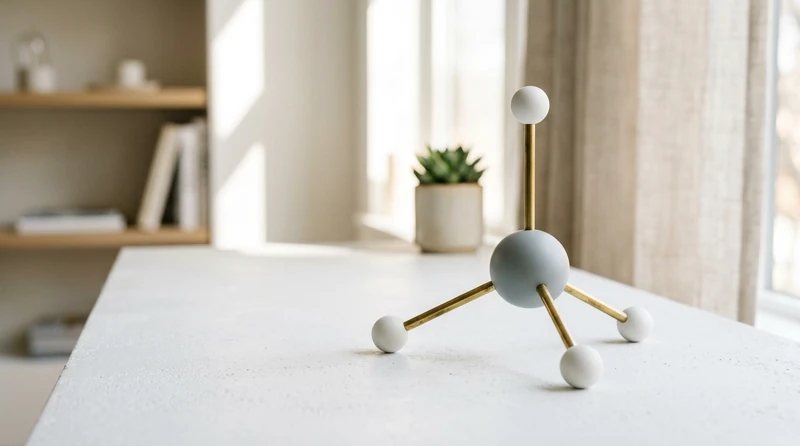
Molecular geometry seems like memorization until you see the rule behind it. VSEPR — Valence Shell Electron Pair Repulsion — says electron domains around a central atom push one another as far apart as they can. That single repulsion idea generates every common molecular shape: linear, trigonal planar, tetrahedral, trigonal pyramidal, bent. This guide on molecular geometry and VSEPR walks through how to count domains, how to get from "electron-domain geometry" to "molecular geometry," and the five cases that cover most exam questions.
The Big Idea: Electrons Repel, So Domains Spread Out
Each pair of electrons around a central atom — whether bonding or non-bonding — repels every other pair. To minimize that repulsion, the electron pairs (more generally, electron domains) arrange themselves as far apart in 3D as possible. The geometry that results from that spreading is called the electron-domain geometry.
A few key definitions before we count.
An electron domain is anything that occupies a region of space around the central atom: a single bond, a double bond, a triple bond, or a lone pair. A double bond counts as one domain, not two — VSEPR cares about the location of electrons, not the number of bonds in that location.
The steric number is the total count of electron domains on the central atom: bonded atoms plus lone pairs. Steric number sets the electron-domain geometry.
The molecular geometry is the shape of the atoms only. It is the electron-domain geometry with the lone pairs invisible. The two coincide when there are no lone pairs and diverge when there are.
Counting Domains in Two Steps
Given a Lewis structure (you need one, so draw it first if not given):
- Pick the central atom — usually the least electronegative atom that is not hydrogen.
- Count the electron domains on the central atom: number of atoms bonded to it, plus number of lone pairs on it.
That count is the steric number, and it picks the electron-domain geometry from the table.
| Steric # | Electron-domain geometry | Bond angle |
|---|---|---|
| 2 | Linear | 180° |
| 3 | Trigonal planar | 120° |
| 4 | Tetrahedral | 109.5° |
| 5 | Trigonal bipyramidal | 90°, 120° |
| 6 | Octahedral | 90° |
Then convert to molecular geometry by removing lone pairs from the picture.

The Five Cases You See Most
Almost every general-chemistry molecule falls into one of these five.
Steric 2: CO₂ — linear
Central C, two double bonds to O, no lone pairs on C. Steric number = 2. Electron-domain geometry: linear. No lone pairs, so molecular geometry: linear, bond angle 180°.
Steric 3: BF₃ vs. SO₂
BF₃ has central B, three single bonds, no lone pairs. Steric number = 3, trigonal planar electron-domain geometry. No lone pairs → molecular geometry: trigonal planar, 120°.
SO₂ has central S, with one double bond, one single bond (or two equivalent bonds by resonance), and one lone pair. Steric number = 3, trigonal planar electron-domain geometry. One lone pair "pushes" the two oxygens closer, so molecular geometry: bent, bond angle slightly less than 120° (≈ 119°).
Steric 4: CH₄, NH₃, H₂O
These three are the classic tetrahedral-family trio.
CH₄ — central C, four bonds, zero lone pairs. Steric = 4, tetrahedral electron-domain geometry. Zero lone pairs → molecular geometry: tetrahedral, 109.5°.
NH₃ — central N, three bonds, one lone pair. Steric = 4, tetrahedral electron-domain geometry. One lone pair → molecular geometry: trigonal pyramidal, bond angle ≈ 107° (slightly compressed by the lone pair).
H₂O — central O, two bonds, two lone pairs. Steric = 4, tetrahedral electron-domain geometry. Two lone pairs → molecular geometry: bent, bond angle ≈ 104.5°.
Steric 5: PCl₅ and SF₄
PCl₅ — five bonds, no lone pairs. Steric = 5, trigonal bipyramidal both ways. Molecular geometry: trigonal bipyramidal, bond angles 90° (axial-to-equatorial) and 120° (equatorial-to-equatorial).
SF₄ — four bonds, one lone pair. Steric = 5, trigonal bipyramidal electron-domain geometry. The lone pair sits in the equatorial position (more room), making the molecular geometry seesaw.
Steric 6: SF₆ and XeF₄
SF₆ — six bonds, no lone pairs. Steric = 6, octahedral both ways. Molecular geometry: octahedral, 90°.
XeF₄ — four bonds, two lone pairs. Steric = 6. The two lone pairs sit on opposite axes (180° apart, the maximum). Molecular geometry: square planar.
Why Lone Pairs Compress Bond Angles
A lone pair occupies more space than a bonding pair because it is held by only one nucleus instead of two. So a lone pair pushes harder than a bond, squeezing the bonded atoms closer together. That is why NH₃ comes in at ≈ 107° and H₂O at ≈ 104.5°, both below the ideal tetrahedral 109.5°. The same effect explains SO₂'s slightly compressed 119°.
This is also why lone pairs prefer equatorial positions in trigonal bipyramidal geometries — equatorial spots have more room (120° to two neighbors, 90° to two more), while axial spots are crowded (90° to four neighbors). The geometry with lone pairs in the roomiest spots is the one observed.
A Common Pitfall: Counting a Double Bond as Two Domains
A double or triple bond is one electron domain, not two. VSEPR cares about regions of space, and a double bond is one region (even though it contains four electrons). For CO₂, the carbon has two electron domains (one for each double-bonded oxygen), not four. Counting bonds instead of domains is the single most common error in VSEPR.
Getting Help
VSEPR predicts shape from Lewis structures, so a fast Lewis-structure habit is the prerequisite. For the related bonding-type recognition, see ionic vs. covalent bonds. For more practice with the foundational gen-chem topics, browse the General Chemistry study guides.
Conclusion
VSEPR turns molecular geometry into a counting problem. Add up the electron domains on the central atom (bonded atoms plus lone pairs, double bonds count as one) to get the steric number; the steric number picks the electron-domain geometry. Then take out the lone pairs to get the molecular geometry of the atoms. Five steric numbers — 2, 3, 4, 5, 6 — and their lone-pair variants cover almost every molecule in an intro course, and the rule of "lone pairs push harder than bonds" explains every compressed-angle exception.