
IUPAC names look intimidating until you see they follow a fixed five-step recipe. Pick the longest chain, number it so the substituents get the lowest possible numbers, name each substituent, list them alphabetically, and assemble. This guide on IUPAC naming basics walks through the rules for straight-chain and branched alkanes, then runs three worked examples that cover every common trap.
The Five-Step Recipe
Naming any alkane follows the same steps. Run them in order.
- Find the longest continuous chain of carbons. That is the parent chain. Its length sets the base name.
- Number the chain starting from the end that gives the lowest set of locants to the substituents. "Locant" is just the position number of a substituent.
- Identify and name each substituent. Branches are named as alkyl groups (one carbon shorter than the parent stub: methyl, ethyl, propyl, butyl).
- List substituents alphabetically in the final name, with their locants. Use prefixes (di-, tri-, tetra-) for repeats, but do not count those prefixes for alphabetization.
- Assemble: locants–substituents–parent-name. Separate numbers from letters with hyphens, numbers from each other with commas.
The base names you need to memorize are the carbon-count stems: meth (1), eth (2), prop (3), but (4), pent (5), hex (6), hept (7), oct (8), non (9), dec (10). Add -ane for an alkane (single bonds only): methane through decane.
Step 1 in Detail: Finding the Parent Chain
The parent chain is the longest unbroken carbon chain you can trace through the molecule. Two pitfalls:
- The longest chain may not be the one drawn horizontally. Always count carbons end-to-end through any path; the chain can bend.
- If two chains are tied for longest, pick the one with more substituents (so the structure reads as branched rather than straight).
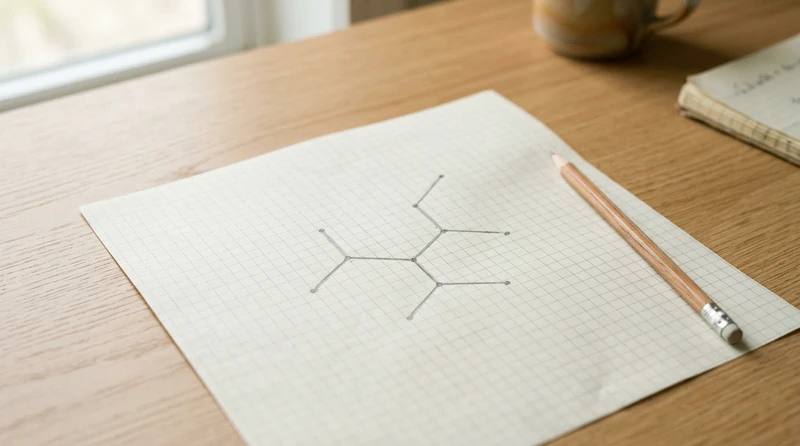
So in a structure like CH₃–CH(CH₃)–CH₂–CH₂–CH₃, count straight across: C₁–C₂–C₃–C₄–C₅, with a methyl branch at C₂. Five carbons in the parent → pentane base.
Step 2 in Detail: Numbering for Low Locants
Number the parent chain from whichever end gives the substituents the lowest set of position numbers.
- Compare the locants going one way vs. the other.
- The "lower set" rule means first point of difference: compare the locants in order until one set has a lower number at some position.
For the pentane example, methyl can be at position 2 (numbering from the left) or position 4 (from the right). 2 < 4, so number from the left. The methyl is at C₂, name is 2-methylpentane.
If two numbering directions give the same locant for the first substituent, look at the second, and so on. Alphabetical order does not enter here yet — that is a step-4 issue.
Step 3 in Detail: Naming Substituents
The branch name comes from the carbon count of the branch, with the -yl suffix.
- 1 C → methyl
- 2 C → ethyl
- 3 C → propyl (or isopropyl for the branched 3-C form)
- 4 C → butyl, sec-butyl, isobutyl, tert-butyl depending on attachment
For intro problems, almost all substituents are straight-chain methyl, ethyl, propyl, and butyl. The "iso", "sec", "tert" prefixes appear for branched substituents — useful to recognize but rarely the focus of a basic IUPAC question. Halogens get their own prefixes: fluoro-, chloro-, bromo-, iodo-.
Steps 4 and 5: Alphabetical Listing and Assembly
When the molecule has more than one substituent:
- List them alphabetically in the final name.
- Use di-, tri-, tetra- for identical substituents at different positions, with a comma-separated locant list.
- Ignore di-, tri-, tetra- when alphabetizing, but do count sec- and tert- only if they are italicized prefixes that follow a hyphen.
Punctuation is rigid: hyphens between numbers and letters, commas between numbers, no spaces inside the name. The whole thing is one closed-up word with one space before "acid" or "amine" suffixes when those appear.
Three Worked Examples
Example 1: A straight-chain alkane
Structure: CH₃–CH₂–CH₂–CH₂–CH₃
Five carbons, no branches. Parent: pentane. No substituents to number, no locants needed. Name: pentane.
Example 2: One branch
Structure: CH₃–CH₂–CH(CH₃)–CH₂–CH₂–CH₃
Step 1 — longest chain: count straight through: C–C–C–C–C–C, six carbons. Parent: hexane.
Step 2 — number for low locants. The methyl branch sits on the third carbon from the left or the fourth from the right. 3 < 4, so number from the left. Methyl is at C₃.
Step 3 — substituent: a one-carbon branch is methyl.
Steps 4–5 — assemble: 3-methylhexane.
Example 3: Multiple substituents
Structure: a six-carbon chain with methyl groups at C₂ and C₄, and a chloro at C₅ (numbering left to right).
Step 1 — parent: hexane.
Step 2 — pick the numbering. Left-to-right gives locants {2, 4, 5} for {methyl, methyl, chloro}. Right-to-left gives {2, 3, 5} for {chloro, methyl, methyl}. Compare at the first point of difference: both start at 2. Second value: 3 < 4. Right-to-left wins. So under right-to-left numbering, the chloro is at C₂, methyls at C₃ and C₅.
Step 3 — substituents: 2-chloro, 3-methyl, 5-methyl.
Step 4 — alphabetize: chloro before methyl. Use di for the two methyls.
Step 5 — assemble: 2-chloro-3,5-dimethylhexane.
The substituents share the parent name, the locants come from numbering, alphabetization fixes the listing order. Five steps, one name.
Common Mistakes
- Naming the longest visible chain instead of the longest possible chain. The longest chain can bend through the structure. Always count through every reasonable path.
- Numbering from the wrong end. Use the lowest-set-of-locants rule, not alphabetical priority.
- Forgetting to alphabetize when listing. "Bromo" comes before "chloro" comes before "methyl". The locants stay tied to their substituents.
- Hyphen and comma errors. Numbers separated by commas, numbers and letters by hyphens. No spaces inside the name itself.
Getting Help
Functional groups change the picture — once you have a double bond, an alcohol, or a carboxylic acid in the structure, the parent name suffix changes and the numbering rules add priority constraints. See intro to organic chemistry: functional groups for the recognition step before naming.
Conclusion
IUPAC naming basics is a five-step recipe: find the longest chain, number it for the lowest locants, name each substituent, alphabetize them, and assemble. Master the recipe on alkanes — straight-chain and branched — and you have the framework for naming alcohols, alkenes, and every other functional group, because each one just adds priority rules on top of the same five steps. Three or four practice molecules and the procedure becomes automatic.