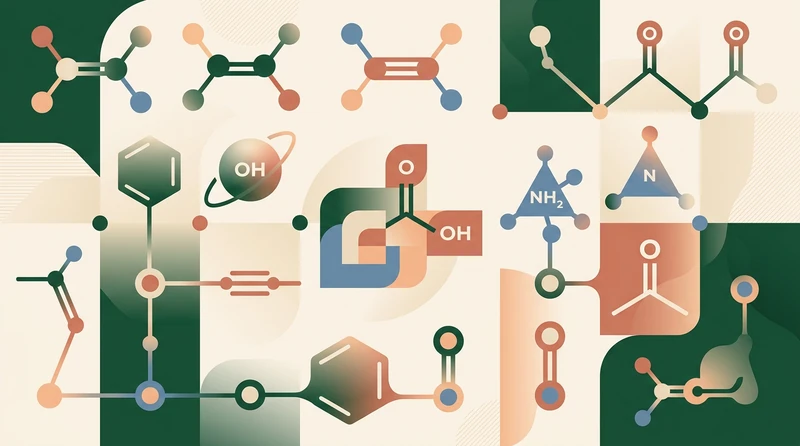
Organic chemistry seems like a million reactions until you notice the same handful of features showing up over and over. Those features — the functional groups — are the verbs of the language. Most reactions in an intro course are a thing happening to a functional group, while the carbon chain around it sits there as scenery. This intro to organic chemistry functional groups covers the ten you must know cold: what they look like, how they show up in IUPAC names, and the one behavior each one is famous for.
What "Functional Group" Means
A functional group is a specific arrangement of atoms inside an organic molecule that controls how the molecule reacts. The same group behaves the same way no matter how big or branched the rest of the molecule is, so once you know the group, you know roughly what reactions to expect. That is what makes them so valuable: instead of memorizing thousands of compounds, you learn maybe a dozen groups and recognize them on sight.
In structures, the carbon chain is often abbreviated as R (or R, R', R'') to focus attention on the group. R is "the rest of the molecule" — anything from a methyl group to a long branched chain. R–OH means an alcohol; what R is does not change the fact that there is an –OH attached to a carbon.
The Ten You Cannot Skip
Here is the working set. Memorize the structure, the suffix (if any), and the one-line behavior for each.
1. Alkane — C–C single bonds only. No functional group, really; it is the baseline. Suffix: -ane (methane, ethane, propane). Behavior: unreactive under most conditions, undergoes combustion and free-radical halogenation.
2. Alkene — C=C double bond. Suffix: -ene (ethene, propene). Behavior: undergoes addition reactions — H₂, HX, X₂, H₂O — that break the π bond and add atoms across the two carbons. The C=C is electron-rich and electrophiles love it.
3. Alkyne — C≡C triple bond. Suffix: -yne (ethyne, propyne). Behavior: similar addition reactions to alkenes, can be added across twice. Terminal alkynes (with an H on the triple-bond carbon) are mildly acidic.
4. Aromatic ring — a benzene ring (C₆H₆) or its substituted versions. Suffix: usually named as substituted benzenes or with a retained name like toluene. Behavior: very stable thanks to delocalized π electrons; undergoes electrophilic aromatic substitution rather than addition, preserving the ring.
5. Alcohol — R–OH. Suffix: -ol (methanol, ethanol). Behavior: weak acid, hydrogen-bonds (so high boiling points), can be oxidized to an aldehyde, ketone, or carboxylic acid depending on whether it is primary, secondary, or tertiary.
6. Ether — R–O–R'. No standard suffix; named "alkyl alkyl ether" or with the prefix "alkoxy-". Behavior: largely inert, good solvents (diethyl ether, THF). The lone pairs on oxygen accept hydrogen bonds but cannot donate, so ethers have lower boiling points than alcohols.
7. Amine — R–NH₂ (primary), R₂NH (secondary), R₃N (tertiary). Suffix: -amine. Behavior: weak base, lone pair on nitrogen accepts protons. Hydrogen-bonds (for 1° and 2° amines). The lone pair is also a nucleophile — amines attack electrophilic carbons.
8. Aldehyde — R–CHO (a C=O with at least one H on the carbonyl carbon). Suffix: -al (methanal/formaldehyde, ethanal/acetaldehyde). Behavior: easily oxidized to a carboxylic acid; the carbonyl carbon is electrophilic and is attacked by nucleophiles.
9. Ketone — R–CO–R' (a C=O with carbons on both sides). Suffix: -one (propanone/acetone, butanone). Behavior: like aldehydes the C=O is electrophilic and accepts nucleophiles, but ketones do not oxidize further easily — that is what distinguishes them from aldehydes.
10. Carboxylic acid — R–COOH. Suffix: -oic acid (methanoic/formic acid, ethanoic/acetic acid). Behavior: weak acid (pK(a) about 3–5), more acidic than alcohols by far because the conjugate base is resonance-stabilized. Forms esters with alcohols and amides with amines.
Two close relatives of the carboxylic acid are worth listing alongside, because they are derivatives:
- Ester — R–COO–R'. Suffix: -oate (ethyl ethanoate). Made from a carboxylic acid plus an alcohol, water leaving. Pleasant-smelling — many fruit aromas are esters.
- Amide — R–CO–NR'R''. Suffix: -amide. Made from a carboxylic acid plus an amine. The amide bond is the backbone of every protein.
How to Spot a Group Fast
Two habits make recognition automatic.
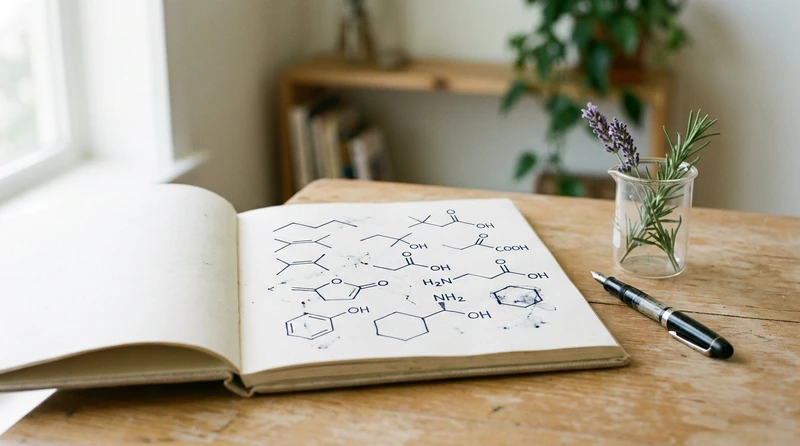
First, look for the heteroatom — anything that is not carbon or hydrogen. Oxygen and nitrogen are the giveaways. An –OH bonded to a carbon is almost certainly an alcohol; an –O– between two carbons is an ether; a C=O with an –OH is a carboxylic acid; a C=O with an –NR₂ is an amide.
Second, look at the bond order between carbons. A C=C is an alkene; a C≡C is an alkyne; a ring of alternating bonds with delocalized π electrons is aromatic. Saturated single bonds with no heteroatoms is just an alkane.
When two groups are present, the higher-priority group sets the suffix and the lower one becomes a prefix. The priority for naming (high to low) runs roughly: carboxylic acid > ester > amide > nitrile > aldehyde > ketone > alcohol > amine > alkene/alkyne. Carbonyl groups beat alcohols, which beat amines, which beat the double bond.
Why This List Pays Off
Almost every reaction in an intro course is one of: addition across a double bond, substitution on an aromatic ring, oxidation or reduction of a C–O group, acid–base proton transfer involving a carboxylic acid or amine, or nucleophilic attack on a carbonyl. Each of those is keyed to a functional group. If you can name the group in a structure, you can predict the class of reaction it will do — which is what an organic chemistry exam tests, sentence after sentence.
Getting Help
The next step is naming whole molecules — see IUPAC naming basics for the rules that turn a structure into a name and back. For the bigger picture of where these groups fit in general chemistry, browse the General Chemistry study guides.
Conclusion
Functional groups are the shortcut that makes organic chemistry learnable. Ten of them — alkanes, alkenes, alkynes, aromatics, alcohols, ethers, amines, aldehydes, ketones, and carboxylic acids — plus the two acid derivatives (esters and amides) cover almost every structure you will be shown in an intro course. Learn the picture, the suffix, and the one-line behavior of each, and most "what reaction would this undergo?" questions become quick recognition rather than memorization.