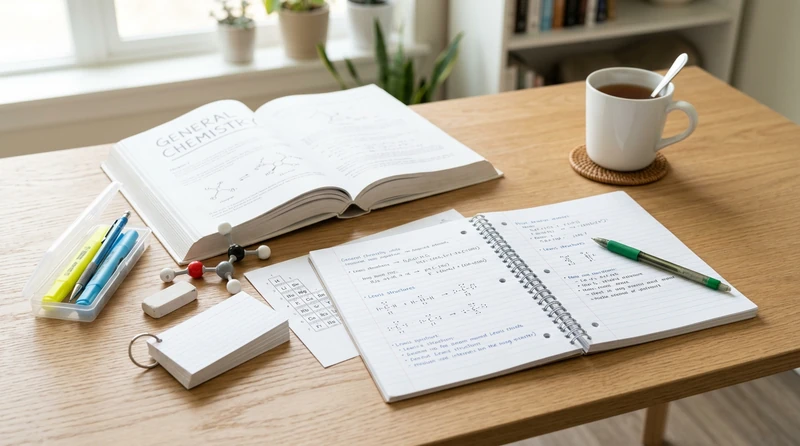
General chemistry punishes the study method that worked in earlier classes. Rereading the chapter and highlighting feels productive, but a chemistry exam does not ask you to recognize concepts — it asks you to solve with them, under time pressure. This guide explains how to study for a general chemistry exam in a way that matches what the test actually measures.
Why Rereading Fails in Chemistry
Chemistry exams are roughly 80% problem-solving: balance this, find the limiting reactant, calculate the pH. Rereading your notes builds recognition — the comfortable feeling that you have seen something before — but recognition is not retrieval, the ability to produce a solution from a blank page.
The fix is to study the way the exam tests. Do problems, closed-book, then check. A worked example you follow along with looks easy; the same problem with the solution covered exposes exactly which step you cannot reproduce. That gap is your real study list — and you only find it by attempting problems, not by reading them.

Build a Formula Sheet From Scratch
Make your own one-page formula sheet — and the making is the point, even if the exam will not let you bring it.
Going through the unit and writing out every equation forces you to decide what each variable means, which units it takes, and when the formula applies. Organize it by problem type, not by chapter:
- Stoichiometry: molar mass, the mole-ratio relationship, percent yield.
- Gases: PV = nRT and the combined gas law, with the rule that temperature must be in Kelvin.
- Acids and bases: pH = −log[H⁺], pH + pOH = 14.
- Thermochemistry: q = mcΔT and Hess's law.
Beside each formula, write the one situation that triggers it. A formula sheet that just lists equations is half-built; the trigger is what tells you which one to reach for mid-exam.
Practice Under Test Conditions
Most general chemistry exams are tight on time. You can know every concept and still run out of clock if every practice problem was untimed and open-book.
Two weeks out, shift to timed problem sets: a fixed number of problems, a real clock, no notes, no looking ahead. Use old exams or end-of-chapter problems if a practice exam is not provided. This trains the skill the test grades — fast, accurate retrieval — and it surfaces the careless errors (a Celsius temperature left unconverted, a misread subscript) that only show up at exam pace.
Keep an error log
For every problem you miss, write one line: what went wrong and the correct move. Sort the lines and a pattern appears — maybe half your errors are sign mistakes in logarithms, or forgetting to balance before applying a mole ratio. A targeted fix list of five recurring mistakes is worth more than another full re-read.
Don't neglect the conceptual questions
The other 20% of a chemistry exam is conceptual: rank these atoms by radius, predict whether a reaction is exothermic, explain why ice floats. These questions reward understanding the why behind a method, and they are where students who only drilled calculations lose points.
The study move here is different from problem drilling. After you can execute a method, force yourself to explain it out loud, without numbers — why does the limiting reactant cap the product, why does each pH unit mean a tenfold concentration change. If you cannot explain it in plain words, you have memorized a procedure without understanding it, and a conceptual question will expose that.
A useful test: take a worked problem and ask "what would change if I doubled this quantity?" If you can predict the effect without redoing the arithmetic, you understand the relationship. If you have to recompute, you do not yet.
A Realistic One-Week Timeline
Cramming chemistry the night before does not work, because problem-solving fluency needs spaced repetition. A workable final week:
- Days 7–5: Rework the hardest problem type from each unit, closed-book. Build the formula sheet as you go.
- Days 4–3: Mixed problem sets — pull problems from all units in random order, so you practice identifying the type, not just executing a known one.
- Day 2: One full timed practice exam. Grade it. Build your error log.
- Day 1: Review the error log and the formula sheet only. No new material. Sleep — fatigue makes exactly the careless arithmetic errors chemistry punishes hardest.
Getting Help
The fastest way to raise a chemistry score is to drill the specific methods the exam reuses. Walkthroughs like balancing chemical equations and limiting reactant problems give you the step-by-step procedures worth practicing closed-book.
Conclusion
How to study for a general chemistry exam comes down to matching your method to the test: it grades problem-solving, so practice solving — closed-book, timed, with an error log catching your patterns. Build your own formula sheet to learn when each equation applies, and spread the work across a week so retrieval becomes automatic. Recognition feels like studying; retrieval is what earns the grade.