pH looks simple — a number from 0 to 14 — until a problem asks you to find the pH of a 0.001 M acid, or to go backward from pH to concentration. The confusion is almost always the logarithm. This guide explains what pH and pOH actually measure, why the scale is logarithmic, and how to move between concentration and pH in either direction.
What pH and pOH Actually Measure
pH is a measure of how acidic or basic a solution is, based on its hydrogen-ion concentration, written [H⁺]. The definition is a logarithm:
pH = −log[H⁺]
The "p" means "take the negative base-10 log of." So pOH applies the same operation to hydroxide ions:
pOH = −log[OH⁻]
A low pH means a high [H⁺] — acidic. A high pH means a low [H⁺] — basic. At 25 °C, pH 7 is neutral, below 7 is acidic, above 7 is basic. The negative sign exists so that the typical small concentrations (like 10⁻⁵ M) come out as convenient positive numbers (like 5) instead of awkward negative exponents.
Why the Scale Is Logarithmic
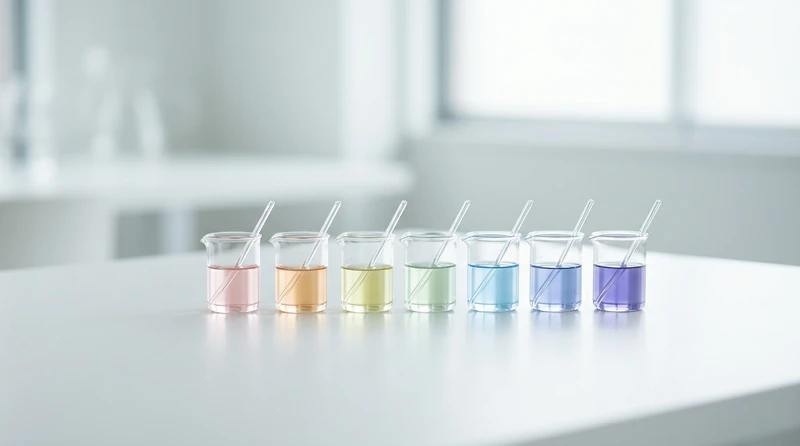
This is the part that matters most. Because pH is a log scale, each whole-number step is a factor of 10 in concentration.
A solution at pH 3 is not "a little more acidic" than pH 4 — it has 10 times the hydrogen-ion concentration. pH 3 versus pH 6 is a factor of 10³, a thousandfold difference. The scale compresses an enormous range — [H⁺] in real solutions spans from about 1 M down to 10⁻¹⁴ M — into a tidy 0-to-14 span.
So when a problem changes pH by 2, the concentration changed by 100×. Treating pH steps as if they were linear is the single most common conceptual error here.
The Relationship That Ties It Together
In any aqueous solution at 25 °C, water itself sets a fixed link between [H⁺] and [OH⁻]: their product is always 1.0 × 10⁻¹⁴, called the ion-product constant of water, K_w.
Take the negative log of that whole equation and it collapses to a rule you will use constantly:
pH + pOH = 14 (at 25 °C)
This means you never need both. Find one and subtract from 14 for the other. A solution with pOH 11 has pH 3. A neutral solution splits it evenly: pH 7, pOH 7.
Worked Examples in Both Directions
Concentration to pH. A solution has [H⁺] = 2.5 × 10⁻⁴ M. Then pH = −log(2.5 × 10⁻⁴) = 3.60. It is acidic, as a [H⁺] well above 10⁻⁷ should be. Its pOH is 14 − 3.60 = 10.40.
pH to concentration. A solution has pH 8.20. To undo the log, raise 10 to the negative power: [H⁺] = 10⁻ᵖᴴ = 10⁻⁸·²⁰ = 6.3 × 10⁻⁹ M. The pH above 7 told you in advance it would be basic, with [H⁺] below 10⁻⁷.
Starting from pOH. Suppose you are told [OH⁻] = 4.0 × 10⁻³ M. Take pOH = −log(4.0 × 10⁻³) = 2.40, then pH = 14 − 2.40 = 11.60. A pH near 12 confirms a strongly basic solution. You can compute either the H⁺ or the OH⁻ branch first — pH + pOH = 14 always connects them.
A note on significant figures
In a logarithm, only the digits after the decimal point count as significant. [H⁺] = 2.5 × 10⁻⁴ has two significant figures, so the pH is written 3.60 — two decimal places. The "3" just locates the exponent and does not count. This rule surprises people and quietly costs exam points.
Strong Acids and Bases: A Shortcut
For a strong acid or strong base, the pH problem gets shorter, because a strong acid ionizes completely in water. Every molecule donates its proton.
That means for a strong monoprotic acid like HCl, the hydrogen-ion concentration simply equals the acid's concentration. A 0.010 M HCl solution has [H⁺] = 0.010 M = 1.0 × 10⁻², so pH = −log(0.010) = 2.00 — no equilibrium calculation needed. The same logic runs in reverse for a strong base: 0.010 M NaOH has [OH⁻] = 0.010 M, so pOH = 2.00 and pH = 12.00.
Weak acids and bases do not ionize completely, so their [H⁺] is less than the stated concentration and you need an equilibrium constant to find it. But recognizing a strong acid or base lets you skip straight to the −log step, and that recognition is worth points on any timed exam.
Getting Help
pH problems lean on confident handling of exponents and ratios. For the broader toolkit of chemical calculation, browse the General Chemistry study guides.
Conclusion
Understanding pH and pOH starts with reading them as logarithms: pH = −log[H⁺], and every whole-number step is a tenfold change in concentration. pH + pOH = 14 at 25 °C, so one always gives you the other. To go from concentration to pH take the negative log; to go back, raise 10 to the negative pH. Keep the log significant-figure rule in mind and the scale stops being mysterious.