
Blood typing seems like a chart-memorization problem at first glance — four ABO types, two Rh statuses, eight total combinations. Once you understand why the body reacts to the wrong blood, the chart writes itself. Blood types are defined by antigens on the surface of red blood cells, and the immune system has antibodies to whatever antigens it does not carry. Mix incompatible types and antibodies bind donor red cells immediately. This article walks you through the ABO system, the Rh system, the transfusion reaction itself, and what "universal donor" and "universal recipient" actually mean.
What Makes a Blood Type: Antigens and Antibodies
Every red blood cell has surface markers — short carbohydrate or protein chains — called antigens. Two systems matter most for transfusion: the ABO system, which classifies the carbohydrate antigens A and B, and the Rh system, which classifies the D protein antigen (the most clinically important Rh antigen).
The body's plasma carries antibodies to any antigen its own red blood cells do not display. These are not learned — they appear without any prior exposure, possibly because we are constantly exposed to similar carbohydrate structures on gut bacteria from infancy. The rule is consistent: if your cells carry antigen A, you make anti-B antibodies. If your cells carry antigen B, you make anti-A. If you carry neither, you make both. If you carry both, you make neither.
That rule is the entire ABO logic. Most exam questions about blood types reduce to applying it.
The ABO System
There are four ABO types, based on which of the two antigens (A, B) are present on the red blood cell surface:
- Type A — red cells have antigen A; plasma has anti-B antibodies.
- Type B — red cells have antigen B; plasma has anti-A antibodies.
- Type AB — red cells have both A and B antigens; plasma has no anti-A or anti-B.
- Type O — red cells have neither A nor B; plasma has both anti-A and anti-B.
The frequencies vary by population, but globally type O is the most common, AB the least.
The blood-type chart for transfusion follows directly:
- AB is the universal recipient for red cells. AB plasma carries no anti-A or anti-B, so an AB person can receive A, B, AB, or O red cells without an immediate reaction.
- O is the universal donor for red cells. Type O red cells display no A or B antigen, so they are not attacked by any recipient's anti-A or anti-B antibodies.
(Plasma works in the opposite direction, since the donor's antibodies are what matter — universal donor for plasma is AB, universal recipient is O. Most exam questions are about red cells.)
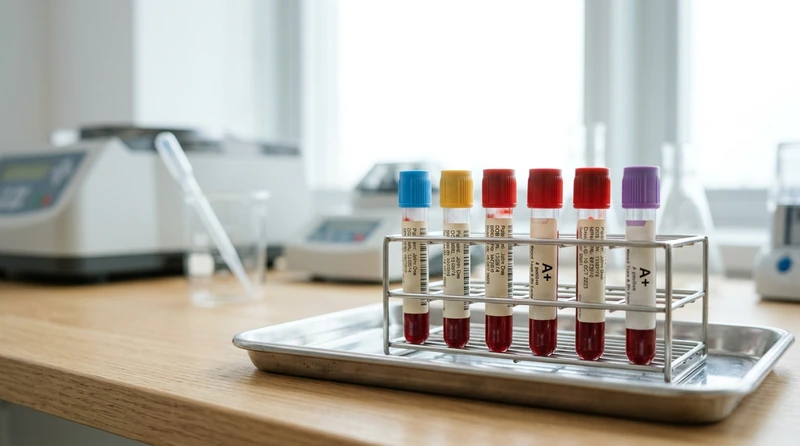
The Rh System
The Rh system layers on top of ABO. The most important antigen in this system is antigen D.
- Rh-positive (Rh⁺) — red cells carry antigen D. About 85% of the population.
- Rh-negative (Rh⁻) — red cells do not carry antigen D. About 15% of the population.
The Rh system has a key twist that the ABO system does not. Anti-D antibodies are not naturally present in Rh-negative blood. They are only produced after an Rh-negative person has been exposed to Rh-positive blood — for example, from a previous transfusion or pregnancy. So:
- An Rh-negative person's first exposure to Rh-positive blood may cause no immediate reaction, but the body makes anti-D antibodies.
- A second exposure to Rh-positive blood now triggers a fast, severe reaction because anti-D antibodies are already circulating.
This is why blood is matched for both ABO and Rh. The eight clinical types are A+, A−, B+, B−, AB+, AB−, O+, O−. O-negative is the universal donor for red cells because it has no A antigen, no B antigen, and no D antigen — there is nothing on those cells for any recipient's antibodies to react to.
What a Transfusion Reaction Actually Looks Like
Give a type A patient type B blood. The patient's anti-B antibodies in their plasma bind to the B antigens on the donor red cells almost immediately. Two destructive processes follow:
- Agglutination — antibodies are bivalent, so each can grab two red cells. The donor cells clump together into visible aggregates. Those clumps obstruct small blood vessels, especially in the kidneys.
- Hemolysis — the antibodies activate the complement system, a chain of plasma proteins that punches holes in the donor red cell membranes and bursts them. The released hemoglobin enters the plasma and is filtered by the kidneys, where it can damage the tubules.
The patient may experience fever, chills, lower-back pain, falling blood pressure, and dark urine within minutes. Severe reactions can cause acute kidney failure and shock. This is why ABO and Rh typing — and a final crossmatch directly mixing donor cells with recipient plasma — is performed before every transfusion.
Hemolytic Disease of the Newborn
The Rh system causes the most important pregnancy-related blood incompatibility. An Rh-negative mother carrying an Rh-positive fetus is generally fine during the first pregnancy because maternal and fetal blood do not normally mix. During delivery, a small amount of fetal blood usually enters the maternal circulation. The mother's immune system sees Rh-positive cells, makes anti-D antibodies, and develops permanent immunity.
If she carries a second Rh-positive fetus, her anti-D antibodies can cross the placenta and attack the fetal red blood cells, causing hemolytic disease of the newborn (erythroblastosis fetalis). Modern prevention is straightforward: Rh-negative mothers receive a shot of Rh immunoglobulin (RhoGAM) during and after pregnancy, which clears fetal Rh-positive cells from the mother's blood before her immune system can react.
Getting Help
The reaction at the heart of a transfusion mismatch is an adaptive-immunity event — antibodies binding antigens and triggering complement, as covered in the lymphatic and immune system. For more A&P walkthroughs, see the full set of Anatomy & Physiology study guides.
Conclusion
Blood types and Rh factor are easier than the chart suggests once you know the rule: red cells carry antigens, plasma carries antibodies to the antigens you do not have. Mix incompatible types and antibodies bind donor cells, causing agglutination and complement-mediated hemolysis. Type AB is the universal red-cell recipient, type O-negative the universal red-cell donor. The Rh twist is that anti-D antibodies are made only after exposure, which is why Rh incompatibility shows up in second pregnancies and second transfusions, not first ones.