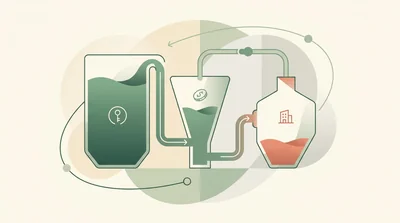
The statement of cash flows splits every cash movement into one of three buckets. Get the classification right and the rest of the statement falls into place; get it wrong and you spend twenty minutes hunting for a $5,000 difference. This guide walks through what each section actually represents, gives a single decision rule, and tests it against the items that trip students up most often.
What Each Section Represents
The three sections answer three different questions about a company.
Operating activities are the cash flows of running the business — collecting from customers, paying suppliers and employees, paying interest and taxes. They are tied to the income statement: anything that touches net income (or current operating assets and liabilities) is operating. Operating cash flow is the headline number; it shows whether the business itself produces cash, separate from how it is financed or what it has invested in.
Investing activities are cash flows from buying or selling long-term assets — equipment, buildings, land, and investments in other companies. They tell you whether the company is putting cash into productive capacity (negative) or selling off pieces of itself (positive). Steady investing outflows are a sign of a company reinvesting in growth; large investing inflows can mean restructuring or divestiture.
Financing activities are cash flows between the company and the people who fund it — owners and creditors. Issuing stock, borrowing from banks, repaying debt, paying dividends, buying back shares: all financing. This section answers whether the company is raising capital or returning it.
The simplest summary: operating is "running the business," investing is "growing or shrinking the asset base," and financing is "moving money in and out from owners and lenders."

The Decision Rule
When you see a cash transaction, ask three questions in order:
- Did it touch a long-term asset? If yes, it is investing. Buying equipment, selling a building, purchasing bonds of another company — all investing.
- Did it involve a lender or owner? If yes, it is financing. Issuing debt, repaying debt, issuing stock, paying dividends, buying back shares — all financing.
- Otherwise — it is operating. Anything left over relates to day-to-day operations.
The order matters. A loan repayment touches cash and a long-term liability; both clues would steer you toward something non-operating. The "investing first, then financing, then operating" order gets the answer right because investing is about long-term assets while financing is about long-term liabilities and equity, with operating absorbing the rest.
Common Items: Where Each One Lands
A quick reference for the items that come up most:
Operating activities
- Cash collected from customers
- Cash paid to suppliers
- Cash paid to employees (wages, salaries)
- Cash paid for utilities, rent, supplies
- Interest paid (U.S. GAAP — IFRS allows financing)
- Interest received and dividends received (U.S. GAAP)
- Income tax paid
Investing activities
- Purchase of equipment, buildings, land
- Sale of equipment, buildings, land
- Purchase of investments in another company (stocks, bonds held as investments)
- Sale of those investments
- Loans made to other parties; collections of principal on those loans
Financing activities
- Issuance of common or preferred stock
- Repurchase of stock (treasury stock)
- Issuance of bonds or notes payable
- Repayment of bond or note principal
- Dividends paid to shareholders
Notice the asymmetry: interest paid is operating, but dividends paid are financing. Both look like "money paid to a capital provider," but accounting treats interest as a cost of doing business (it shows up on the income statement and reduces net income), while dividends are a distribution of after-tax earnings (they never touch the income statement). That is why they sit in different sections.
The Items That Trip Students Up
A handful of cases generate most of the classification mistakes.
Depreciation expense is none of the above — it does not appear in any of the three sections as a cash flow. Depreciation is a non-cash expense; it only appears in the operating section as an add-back under the indirect method, not as its own cash flow. Many students try to slot it into investing because it relates to equipment. Resist that.
Gain or loss on sale of equipment is split across two sections. The cash proceeds from selling the equipment go into investing. The gain or loss itself is removed from operating activities as an indirect-method adjustment (added back if it is a loss, subtracted if it is a gain) because it does not represent operating cash. Two sections, one transaction.
Repayment of a loan splits between sections too. The principal repayment is financing; the interest portion is operating under U.S. GAAP. The bank statement shows one payment; the cash flow statement splits it.
Purchase of inventory on account does not appear directly. The eventual cash payment to the supplier shows up in operating activities — but indirectly, as an increase in accounts payable that gets added back in the working-capital adjustments.
Stock dividends (not the same as cash dividends) involve no cash and do not appear on the statement at all. Only cash dividends paid show up, in financing.
A Quick Worked Sort
A company reports the following during the year. Assign each to a section.
- Issued $50,000 of stock — financing (cash from an owner)
- Bought $30,000 of new equipment — investing (long-term asset acquired)
- Paid $4,000 of interest on a bank loan — operating (cost of doing business)
- Repaid $20,000 of bond principal — financing (return of capital to a lender)
- Collected $200,000 from customers — operating (day-to-day business)
- Sold an old delivery truck for $7,000 cash — investing (long-term asset sold)
- Paid $10,000 cash dividends — financing (distribution to owners)
- Paid $80,000 to suppliers — operating (running the business)
Six items, sorted: three operating, two investing, three financing. The decision rule did all the work — every item answers "long-term asset?" or "lender/owner?" first.
Getting Help
Classifying activities is the setup for actually building the statement. To see those same buckets assembled into a finished cash flow statement with numbers, see statement of cash flows explained, and for a deeper look at the ratios that read those cash and asset figures, see liquidity ratios explained.
Conclusion
Operating vs. investing vs. financing activities is a sorting question with one rule: long-term assets are investing, lender-and-owner movements are financing, and everything else is operating. Keep depreciation out of investing (it is a non-cash add-back), split sales of equipment and loan payments across two sections where needed, and watch the interest-vs.-dividends quirk. Get the classification right and the statement of cash flows comes together cleanly.